Draft ECMA-404
3rd edition / December 8, 2026
The JSON Data Interchange Syntax

Introduction
JSON is a text syntax that facilitates structured data interchange between all programming languages. JSON is a syntax of braces, brackets, colons, and commas that is useful in many contexts, profiles, and applications. JSON stands for JavaScript Object Notation and was inspired by the object literals of JavaScript aka ECMAScript as defined in the ECMAScript Language Specification, Third Edition. However, it does not attempt to impose ECMAScript's internal data representations on other programming languages. Instead, it shares a small subset of ECMAScript's syntax with all other programming languages. The JSON syntax is not a specification of a complete data interchange. Meaningful data interchange requires agreement between a producer and consumer on the semantics attached to a particular use of the JSON syntax. What JSON does provide is the syntactic framework to which such semantics can be attached.
JSON syntax describes a sequence of \u escapement notation.
JSON is agnostic about the semantics of numbers. In any programming language, there can be a variety of number types of various capacities and complements, fixed or floating, binary or decimal. That can make interchange between different programming languages difficult. JSON instead offers only the representation of numbers that humans use: a sequence of digits. All programming languages know how to make sense of digit sequences even if they disagree on internal representations. That is enough to allow interchange.
Programming languages vary widely on whether they support objects, and if so, what characteristics and constraints the objects offer. The models of object systems can be wildly divergent and are continuing to evolve. JSON instead provides a simple notation for expressing collections of name/value pairs. Most programming languages will have some feature for representing such collections, which can go by names like record, struct, dict, map, hash, or object.
JSON also provides support for ordered lists of values. All programming languages will have some feature for representing such lists, which can go by names like array, vector, or list. Because objects and arrays can nest, trees and other complex data structures can be represented. By accepting JSON's simple convention, complex data structures can be easily interchanged between incompatible programming languages.
JSON does not support cyclic graphs, at least not directly. JSON is not indicated for applications requiring binary data.
It is expected that other standards will refer to this one, strictly adhering to the JSON syntax, while imposing semantics interpretation and restrictions on various encoding details. Such standards may require specific behaviours. JSON itself specifies no behaviour.
Because it is so simple, it is not expected that the JSON grammar will ever change. This gives JSON, as a foundational notation, tremendous stability.
JSON was first presented to the world at the JSON.org website in 2001. A definition of the JSON syntax was subsequently published as IETF RFC 4627 in July 2006.
JSON is pronounced /ˈdʒeɪ.sən/, as in "Jason and The Argonauts".
1 Scope
JSON is a lightweight, text-based, language-independent syntax for defining data interchange formats. It was derived from the ECMAScript programming language, but is programming language independent. JSON defines a small set of structuring rules for the portable representation of structured data.
The goal of this specification is only to define the syntax of valid JSON texts. Its intent is not to provide any semantics or interpretation of text conforming to that syntax. It also intentionally does not define how a valid JSON text might be internalized into the data structures of a programming language. There are many possible semantics that could be applied to the JSON syntax and many ways that a JSON text can be processed or mapped by a programming language. Meaningful interchange of information using JSON requires agreement among the involved parties on the specific semantics to be applied. Defining specific semantic interpretations of JSON is potentially a topic for other specifications. Similarly, language mappings of JSON can also be independently specified. For example,
2 Conformance
A conforming JSON text is a sequence of
A conforming processor of JSON texts should not accept any inputs that are not conforming JSON texts. A conforming processor may impose semantic restrictions that limit the set of conforming JSON texts that it will process.
3 Normative References
The following referenced documents are indispensable for the application of this document. For dated references, only the edition cited applies. For undated references, the latest edition of the referenced document (including any amendments) applies.
ISO/IEC 10646, Information Technology - Universal Coded Character Set (UCS)
https://www.iso.org/standard/76835.html
The
https://www.unicode.org/versions/latest
IETF. RFC 8259: "The JavaScript Object Notation (JSON) Data Interchange Format"
Edited by Bray, T. December 2017. https://www.rfc-editor.org/info/rfc8259/
This specification and
4 JSON Text
A JSON text is a sequence of tokens formed from
The six structural tokens:
| Token | Code Point | Name |
|---|---|---|
[ |
U+005B | left square bracket |
{ |
U+007B | left curly bracket |
] |
U+005D | right square bracket |
} |
U+007D | right curly bracket |
: |
U+003A | colon |
, |
U+002C | comma |
These are the three literal name tokens:
| Token | Code Points |
|---|---|
true |
U+0074 U+0072 U+0075 U+0065 |
false |
U+0066 U+0061 U+006C U+0073 U+0065 |
null |
U+006E U+0075 U+006C U+006C |
Any token may be preceded and/or followed by insignificant white space consisting of an arbitrary combination of the following code points: character tabulation (U+0009), line feed (U+000A), carriage return (U+000D), and space (U+0020). Concretely,
5 JSON Values
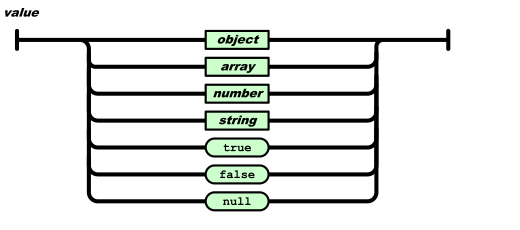
A JSON value can be an object, array, number, string, true, false, or null.
6 Objects
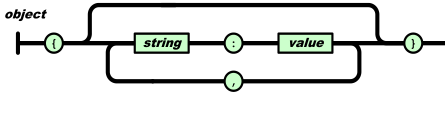
An object structure is represented as a pair of curly bracket tokens surrounding zero or more name/value pairs. A name is a string. A single colon token follows each name, separating the name from the value. A single comma token separates a value from a following name. The JSON syntax does not impose any restrictions on the strings used as names, does not require that name strings be unique, and does not assign any significance to the ordering of name/value pairs. These are all semantic considerations that may be defined by JSON processors or in specifications defining specific uses of JSON for data interchange.
7 Arrays
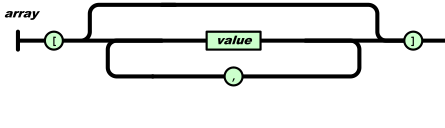
An array structure is a pair of square bracket tokens surrounding zero or more values. The values are separated by commas. The JSON syntax does not define any specific meaning to the ordering of the values. However, the JSON array structure is often used in situations where there is some semantics to the ordering.
8 Numbers
A number is a sequence of decimal digits with no superfluous leading zero. It may have a preceding minus sign (U+002D). It may have a fractional part prefixed by a decimal point (U+002E). It may have an exponent, prefixed by e (U+0065) or E (U+0045) and optionally + (U+002B) or - (U+002D). The digits are the code points U+0030 through U+0039.
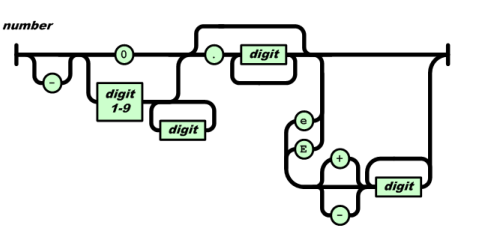
Numeric values that cannot be represented as sequences of digits (such as Infinity and NaN) are not permitted.
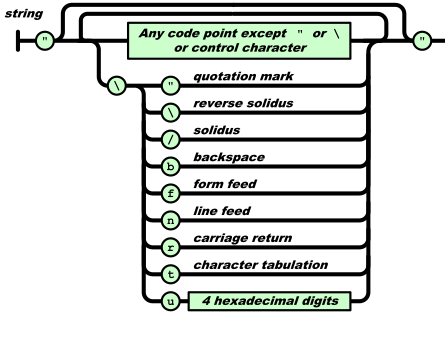
9 Strings
A string is a sequence of
| Escape Sequence | Represents | Code Point |
|---|---|---|
\" |
quotation mark | U+0022 |
\\ |
reverse solidus | U+005C |
\/ |
solidus | U+002F |
\b |
backspace | U+0008 |
\f |
form feed | U+000C |
\n |
line feed | U+000A |
\r |
carriage return | U+000D |
\t |
character tabulation | U+0009 |
So, for example, a string containing only a single reverse solidus character may be represented as "\\".
Any code point may be represented as a hexadecimal escape sequence. The meaning of such a hexadecimal number is determined by u, followed by four hexadecimal digits that encode the code point. Hexadecimal digits can be digits (U+0030 through U+0039) or the hexadecimal letters A through F in uppercase (U+0041 through U+0046) or lowercase (U+0061 through U+0066). So, for example, a string containing only a single reverse solidus character may be represented as "\u005C" .
The following four cases all produce the same result:
"\u002F""\u002f""\/""/"
To escape a code point that is not in the Basic Multilingual Plane, the character may be represented as a twelve-character sequence, encoding the UTF-16 surrogate pair corresponding to the code point. So for example, a string containing only the G clef character (U+1D11E) may be represented as "\uD834\uDD1E". However, whether a processor of JSON texts interprets such a surrogate pair as a single code point or as an explicit surrogate pair is a semantic decision that is determined by the specific processor.
The JSON grammar permits code points for which
Bibliography
ECMA-262, ECMAScript Language Specification
https://www.ecma-international.org/publications-and-standards/standards/ecma-262/
Copyright & Software License
Ecma International
Rue du Rhone 114
CH-1204 Geneva
Tel: +41 22 849 6000
Fax: +41 22 849 6001
Web: https://ecma-international.org/
Copyright Notice
ALTERNATIVE COPYRIGHT NOTICE AND COPYRIGHT LICENSE
© 2026 Ecma International
By obtaining and/or copying this work, you (the licensee) agree that you have read, understood, and will comply with the following terms and conditions.
Permission under Ecma’s copyright to copy, modify, prepare derivative works of, and distribute this work, with or without modification, for any purpose and without fee or royalty is hereby granted, provided that you include the following on ALL copies of the work or portions thereof, including modifications:
(i) The full text of this COPYRIGHT NOTICE AND COPYRIGHT LICENSE in a location viewable to users of the redistributed or derivative work.
(ii) Any pre-existing intellectual property disclaimers, notices, or terms and conditions. If none exist, the Ecma alternative copyright notice should be included.
(iii) Notice of any changes or modifications, through a copyright statement on
the document such as “This document includes material copied from or
derived from The JSON Data Interchange Syntax https://tc39.es/ecma404/.
Copyright © Ecma International.”
Disclaimers
THIS WORK IS PROVIDED “AS IS,” AND COPYRIGHT HOLDERS MAKE NO REPRESENTATIONS OR WARRANTIES, EXPRESS OR IMPLIED, INCLUDING BUT NOT LIMITED TO, WARRANTIES OF MERCHANTABILITY OR FITNESS FOR ANY PARTICULAR PURPOSE OR THAT THE USE OF THE DOCUMENT WILL NOT INFRINGE ANY THIRD PARTY PATENTS, COPYRIGHTS, TRADEMARKS OR OTHER RIGHTS.
COPYRIGHT HOLDERS WILL NOT BE LIABLE FOR ANY DIRECT, INDIRECT, SPECIAL OR CONSEQUENTIAL DAMAGES ARISING OUT OF ANY USE OF THE DOCUMENT.
The name and trademarks of copyright holders may NOT be used in advertising or publicity pertaining to the work without specific, written prior permission. Title to copyright in this work will at all times remain with copyright holders.
Software License
All Software contained in this document ("Software") is protected by copyright and is being made available under the "BSD License", included below. This Software may be subject to third party rights (rights from parties other than Ecma International), including patent rights, and no licenses under such third party rights are granted under this license even if the third party concerned is a member of Ecma International. SEE THE ECMA CODE OF CONDUCT IN PATENT MATTERS AVAILABLE AT https://ecma-international.org/memento/codeofconduct.htm FOR INFORMATION REGARDING THE LICENSING OF PATENT CLAIMS THAT ARE REQUIRED TO IMPLEMENT ECMA INTERNATIONAL STANDARDS.
Redistribution and use in source and binary forms, with or without modification, are permitted provided that the following conditions are met:
- Redistributions of source code must retain the above copyright notice, this list of conditions and the following disclaimer.
- Redistributions in binary form must reproduce the above copyright notice, this list of conditions and the following disclaimer in the documentation and/or other materials provided with the distribution.
- Neither the name of the authors nor Ecma International may be used to endorse or promote products derived from this software without specific prior written permission.
THIS SOFTWARE IS PROVIDED BY THE ECMA INTERNATIONAL "AS IS" AND ANY EXPRESS OR IMPLIED WARRANTIES, INCLUDING, BUT NOT LIMITED TO, THE IMPLIED WARRANTIES OF MERCHANTABILITY AND FITNESS FOR A PARTICULAR PURPOSE ARE DISCLAIMED. IN NO EVENT SHALL ECMA INTERNATIONAL BE LIABLE FOR ANY DIRECT, INDIRECT, INCIDENTAL, SPECIAL, EXEMPLARY, OR CONSEQUENTIAL DAMAGES (INCLUDING, BUT NOT LIMITED TO, PROCUREMENT OF SUBSTITUTE GOODS OR SERVICES; LOSS OF USE, DATA, OR PROFITS; OR BUSINESS INTERRUPTION) HOWEVER CAUSED AND ON ANY THEORY OF LIABILITY, WHETHER IN CONTRACT, STRICT LIABILITY, OR TORT (INCLUDING NEGLIGENCE OR OTHERWISE) ARISING IN ANY WAY OUT OF THE USE OF THIS SOFTWARE, EVEN IF ADVISED OF THE POSSIBILITY OF SUCH DAMAGE.